
Categories
From the Director

Primary Research: Balancing the Sought with the Serendipitious

Primary research: any type of research that you collect yourself through interviews and observations. Primary research is often undertaken after the writer has gained some insight through secondary research, (also known as desk research) which is basically what other people have discovered and reported
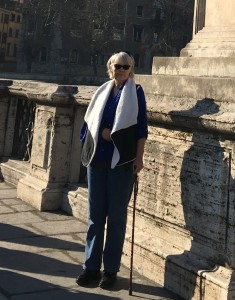
alisonbridgeI have been studying the sixteenth century for around ten years and have written two complete novels set in that time. But except for reading primary sources, such as letters and journals, and a few trips to museums, everything I know I learned from books or the internet. I have not personally time traveled.

Now, for the first time since I fell in love with it, I have the opportunity to visit tiny pockets of the sixteenth century, for it is scattered, almost like debris, all over Europe.

My nature is to make a to-do list and check it off. I want to see the Bramante staircase in the Vatican and the ancient, hidden foundations beneath the Strasbourg Cathedral because I have scenes set in both locations.

But I know it’s important not to obsess over a list. I know it’s important to approach primary research with all senses on alert, thinking constantly: might my character have seen or heard or tasted this? And if so, what would his reaction have been?

I know that, if I pay attention, when I return home to integrate this research into the novel, I will find that the majority of the good stuff I discovered was not on my to-do list.

Your setting may be your own home. You may be creating a character based upon yourself. Nevertheless, approach it as a primary researcher. Seek what you know you need but also recognize what is laid before you unsought that will amp up your story’s authenticity. As writers, we seek the truth, but we also recognize it when it appears unbidden.
Categories
Blog The Merry Grammarian

Why yes, you may end with a preposition

The Merry GrammarianHere’s a question I get asked quite often as a grammar guru: Can you end a sentence in a preposition?

Yes, dear readers. Yes, you can.

Not ending a sentence in a preposition (about, off, at, too, by, etc) is yet another of those grammar myths, similar to the “rule” about not being allowed to start a sentence with a conjunction (and, but, for, yet, or, and so on. As I wrote about in a previous column, it’s totally legit to start a sentence in modern English with a conjunction). And it’s perfectly natural to end a sentence in English with a preposition.

Now, I know many of you were probably taught in school that ending with a preposition is verboten. But believe it or not, there’s never been a formal rule against it. In fact, ending with a preposition is often a clearer and easier way to speak and write in English.

Take, for instance, this example: To whom were you talking? 
Compare that with this: Who were you talking to?

Sure, the first sentence avoids ending with a preposition. But it sounds a little unnatural or dated, more fitting for the Dowager Countess than a modern American-English writer. The second is clearer and plainer—and therefore more easily understood.

Now, there may be times when ending with a preposition can sound clunky or awkward. If that’s the case, then by all means, rearrange.

Still, some may dislike the construction of a sentence that ends in a preposition, and you may find yourself edited or otherwise pressured to change your sentence. If you want to avoid controversy, then go ahead and rearrange.

But if you feel like ending with a preposition, and the sentence is clearer for it, then by all means—go for it. I promise: there are no rules against it.

–Rebecca Mahoney
Categories
Blog The Whole Writer

Trouble Writing? Don’t Beat Yourself Up

Sometimes it seems that the “Whole Writer” becomes the “No Writer” when other things in your life get in the way, preventing you from making progress on your creative writing. Even the most determined, well-disciplined writers have times when their writing takes a back seat to other projects.

Don’t beat yourself up like I tend to do.

I haven’t written anything on my book for two weeks. This is when the negative self-talk begins:

  • Well, I’m not really a writer. I’m just doing it for fun. 
  • Who really cares if I write a book anyway?
  • My writing isn’t very good. I’ll probably never get a publisher.

We’ve all been here. So, what do we do? First, recognize and admit what’s going on. Then, counsel yourself, telling yourself that you’ll soon get back on track.

When you simply can’t dredge up any self-confidence, that’s when you go to a meeting (as they say in support groups). Get yourself to a writing group or workshop or event. Hang out with other writers who are excited about their work and are interested in yours. That’s the best medicine for inspiration and motivation. There are writing groups all over Northwest Arkansas and Southwest Missouri. You probably have a favorite.

You haven’t written for two weeks? So what? Go to a meeting. Get back on schedule.

Indulge yourself. Get lost with your characters again as the summer comes to a close.

Categories
From the Director

Where Writing Can Take You

LAST SUNDAY, I was in pursuit of a word — a word I had seen in the description of a painting at Crystal Bridges. I knew that this word, which describes the connection of the viewer to the artist via the art, was important to my next novel about the German artist Albrecht Dürer. So I returned to the museum in search of that word.

But I never made it. I tripped over a curb in the parking garage, knocked myself silly, broke my shoulder, and took an ambulance ride that I don’t remember.

What made this even more horrific was that I was only a week away from leaving on a trip to verify years of internet research. I had m
ade arrangements to view historic sites not open to the public, conduct interviews, and live for a week in the city where my novel takes place. I had made arrangements for my mother’s care and Traveler’s care and bought a new suitcase, dadgummit.

airportMy broken arm is in a little sling that feels vulnerable, but I have decided to go. I will be accompanied by Village Writing School Board member Stacy Murphy. I’ll be posting and blogging on my website and personal social media about the trip from a research standpoint.

Stacy will be writing as a travel writer. Have you ever thought you’d like to write about the interesting places you visit, whether they are around town or around the world? For the next four weeks, Stacy will have a brief column in this newsletter on what makes a great (i.e., publishable) travel article.

Because you never know where writing will take you.

Categories
The Merry Grammarian

Three Essential Grammar Texts For Any Writer

Sometimes, grammar is downright confounding. All those rules. All those exceptions. Most of us are fuzzy on at least some details. So where can you turn if you’re in need of a definitive grammar source?

The answer, my friend, is not Google. Now, don’t get me wrong, I love Le Google as much as the next person. But too many times, I’ve seen people rely on Google for a grammar question, and the websites that pop up have supplied the wrong answers or have outdated information (remember, as the English language evolves, so does grammar).

Instead, turn to one of these three excellent, straightforward texts—essential reading for any writer seeking a definitive answer to their grammar query, or who simply wants to improve the mechanical side of their writing.

  1. The Elements of Style, by Shrunk & White. Don’t be fooled by the slenderness of this little book. What it lacks in weight, it makes up for in usefulness. Here, in succinct and simple prose, are the essential rules of writing clear, correct English. You’ll find grammar guidance as well as practical instruction on how to improve the clarity of your writing. There’s a reason this slim guide is on the list of required textbooks in English programs across the nation—it’s just that good.
  2. The Chicago Manual of Style. This one might be the opposite of The Elements of Style. It’s a hefty tome, even bigger than my trusty Webster’s dictionary. And where Shrunk and White are lean and clean, CMS goes into detail … deep, intense detail. But it’s got all the information you could ever possibly need, including a robust section on all the grammar particulars of the English language as well as the publishing industry’s preferred style for everything from time to titles. It’s amazing how often I turn to this book—not just when I’m proofreading, but also when I’m writing or editing other people’s work. Turning to CMS is like getting the “official” take—when other sources disagree, this is the text to which I turn.
  3. Eats, Shoots & Leaves, by Lynne Truss. I love this little book on punctuation so much – the title makes it case completely. Whether you’re looking for a refresher on comma usage or just want some clarity around that controversial semicolon, this book will set you straight. And it’s funny, too (always a bonus when you’re talking about grammar). It’s great not just as a reference book, but also as a way to painlessly brush up on your punctuation rules.